

Ford Bronco History
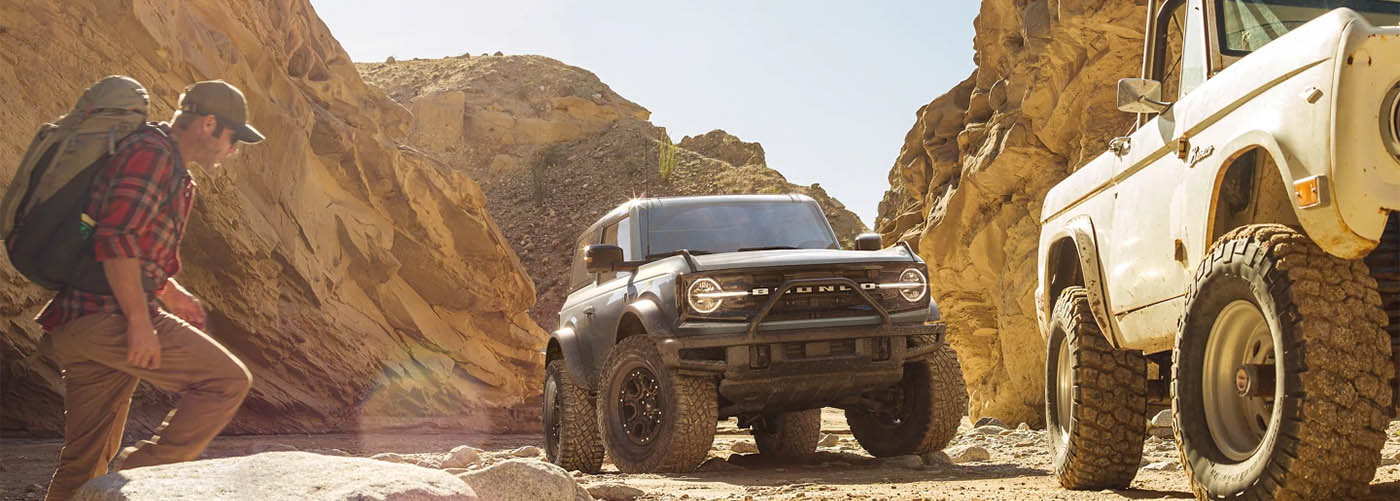
You might think of the classic Ford Bronco as the predecessor to the modern SUV. Designed as a family-friendly all-terrain vehicle, its rugged curb appeal and 92-inch wheelbase stood out in a market that then favored sleek styling. It was the first generation's unpretentious looks and off-road capability that turned the Bronco into an icon, one that ruled the Appleton area's back roads and trails from 1966 to 1977. Below, join Holiday Ford as we explore 60 years of Ford Bronco history, from the classic generations through the modern Bronco available today.
The First Generation (1966-1977)
Designed by the same Ford team behind the original Mustang, the first Bronco was built to compete directly with the Jeep CJ. It came in three body styles: a wagon, a half-cab, and an open-air roadster, with either a 170-cubic-inch six-cylinder or a 289-cubic-inch V8 under the hood. A coil-spring front suspension gave it a smoother ride than most off-roaders of the era, while a durable radius-arm front end helped it hold up to serious trail use. Ford introduced a Special Décor Package in 1976, adding a body-color top and contrasting stripe, shortly before the first generation wrapped up in 1977.
Ford Bronco History Through the 70s, 80s, and 90s
Second Generation (1978-1979)
The second-generation Bronco was built for only two model years before Ford moved on to the third generation. It shared its basic shape with the original but rode on a wider chassis borrowed from the Ford F-100 pickup, giving it a bigger stance and more interior room than the first-generation trucks.
Third Generation (1980-1986)
The third generation was a smaller, lighter take on the full-size Bronco, built through 1986. Around the same time, Ford also introduced a separate, more compact model called the Bronco II (1984-1990), which borrowed its platform and engine from the Ford Ranger rather than the full-size F-Series. The Bronco II wasn't a trim of the full-size Bronco; it was its own smaller model line, and it's considered an early precursor to the modern Ford Explorer.
Fourth Generation (1987-1991)
This generation introduced electronic fuel injection and rear anti-lock brakes, both notable technology upgrades for a body-on-frame SUV at the time. In 1991, its final model year, Ford introduced the Silver Anniversary Edition with leather seating and other comfort-focused updates, marking 25 years since the Bronco's 1966 debut.
Fifth Generation (1992-1996)
The final generation of the original Bronco run added a driver's-side airbag and three-point seatbelts, and by 1994 used a CFC-free air conditioning refrigerant. It also moved to a fixed steel roof, ending the fully open-air, removable-top configuration that had defined earlier generations. Ford ended Bronco production after the 1996 model year, and the nameplate went dormant for more than two decades.
The Sixth-Generation Bronco Returns (2021-Present)
Ford revealed the new Bronco on July 13, 2020, with sales beginning in early 2021, bringing back the body-on-frame construction, removable roof, and removable doors that made the original an off-road favorite. At launch, it offered a 2.3L EcoBoost® turbocharged four-cylinder (270 hp) or an available 2.7L EcoBoost V6 (310 hp), available in both two-door and four-door body styles. Alongside it, Ford also launched the Bronco Sport, a smaller, unibody crossover built on a different platform. It's a separate model line, not a Bronco trim level, aimed at shoppers who want Bronco styling in a more car-like SUV.
In 2022, Ford added the high-performance Bronco Raptor, powered by a 3.0L twin-turbo V6, to the lineup. Engine output on the standard engines has grown since the 2021 launch as well: the 2.3L four-cylinder now makes 300 hp, up from 270 hp, and the 2.7L V6 now makes 330 hp, up from 310 hp.
The Stroppe Edition: Bronco History Comes Full Circle
For 2025, Ford introduced the Bronco Stroppe Edition, named for Bill Stroppe, the off-road racing legend who prepared Broncos for Baja California competition in the late 1960s and 70s. A Stroppe-prepared Bronco won its class outright at the 1969 Baja 1000, a result that helped cement the Bronco's off-road reputation, and Ford brought a consumer "Baja Bronco" version to dealerships in the early 1970s in the years that followed. The modern Stroppe Edition, offered as a two-door model, is a direct nod to that racing heritage, alongside the Heritage Edition trim, which leans on the classic Bronco's styling. It's a good example of how the current Bronco lineup still draws on the truck's original 1960s and 70s reputation.
The 2026 Ford Bronco Lineup
Today's Bronco is offered in seven trims: Base, Big Bend, Outer Banks, Badlands, Heritage Edition, Stroppe Edition, and Bronco Raptor. The 2.3L EcoBoost four-cylinder is standard on Base and Big Bend, paired with a manual transmission as standard and a 10-speed automatic available. Outer Banks and above unlock the 2.7L EcoBoost V6 with a standard 10-speed automatic, and Badlands, Heritage Edition, Stroppe Edition, and Raptor offer additional off-road-focused hardware on top of that.
Exact trim, engine, and transmission availability changes from year to year, so confirm what's currently in stock and what's equipped on a specific vehicle with a Guest Experience Manager before you buy.
See the Ford Bronco and Bronco Sport at Holiday Ford
Ready to see 60 years of Bronco history come together in the current lineup? Browse our new Ford Bronco inventory or new Ford Bronco Sport inventory, then contact us to schedule a time to see one in person at Holiday Ford in Fond du Lac.